- • 172.16.3.0
- • There are congestion problems on the network.
- • The line protocol of the local router is now up.
- • The IP address of each subinterface must be the default gateway address for each VLAN subnet.
- • No clock rate has been set on the DCE interface.
- • The VTP domain names are different.
- • Check the log to see what software components are producing the excess traffic.
- • The packet is routed to R1 and then forwarded out Fa0/0 on R1.
- • VLSM is not supported by RIPv1.
- • The destination host address in an ACL statement is incorrect.
- • divide-and-conquer
- • The command was entered on router R1.
- • The ACL is applied to the wrong interface, but the right direction.
- • It will show network 172.16.3.0 learned from RB.
- • large failure domain • single point of failure.
- • password mismatch for PPP authentication
- • The router interface is in the wrong subnet.
- • The EIGRP process number on R2 is incorrect.
- • Port 0/4 is configured in access mode.20.
- • There is an addressing problem on the link between routers R2 and R3.
- • Workstation 1 is not on the same network that the RTA router LAN interface is on.
- • It should be performed when all switch Cisco IOS versions are upgraded dan • It should be done when the network is performing at normal activity levels.
Kamis, 09 Desember 2010
CCNA Discovery 3 Module 9 Exam Answers Version 4.0
CCNA Discovery 3 Module 9 Exam Answers Version 4.0

CCNA Discovery 3 Module 8 Exam Answers Version 4.0
CCNA Discovery 3 Module 8 Exam Answers Version 4.0
1. • 60
2.• The new commands are added to the end of the current Managers ACL.
3. • Inbound ACLs deny packets before routing lookups are required.
4. • Port 80 should be specified in the ACL.
5. • informational
6. • 172.16.31.77
• 172.16.31.78
7. • 0.0.15.255
8. • specifying internal hosts for NAT
• identifying traffic for QoS
9. • Create an access list permitting only echo reply and destination unreachable packets from the outside.
10• A router automatically reloads in 30 minutes.
11. • 192.168.20.16 to 192.168.20.31
12. • access-list 137 permit ip 192.0.2.0 0.0.0.255 any
access-list 137 permit tcp 198.18.112.0 0.0.0.255 any eq www
13. • Standard ACLs are usually placed so that all packets go through the network and are filtered at the destination.
• Standard ACLs filter based on source address only, and must be placed near the destination if other traffic is to flow.
• Extended ACLs filter with many possible factors, and they allow only desired packets to pass through the network if placed near the source.
14. • access-list 101 deny ip 192.168.3.77 0.0.0.0 192.168.2.0 0.0.0.255
access-list 101 permit ip 192.168.3.0 0.0.0.255 192.168.2.0 0.0.0.255
access-list 101 permit ip 192.168.3.0 0.0.0.255 192.168.1.0 0.0.0.255
15. • access-list 56 deny 172.19.123.0 0.0.0.255
access-list 56 permit any
16. • Router(config)# access-list 101 permit tcp any 192.168.10.25 0.0.0.0 eq telnet
Router(config)# access-list 101 deny ip any any
Router(config)# int s0/0
Router(config-if)# ip access-group 101 in
Router(config-if)# int fa0/0
Router(config-if)#ip access-group 101 in
17. • access-list 101 permit tcp 10.220.158.10 0.0.0.0 host 192.168.3.224 eq 80
18. • 0.0.0.31
19. • Use only Secure Shell (SSH) on the vty lines.
20. • A large amount of ICMP traffic is being denied at the interface, which can be an indication of a DoS
1. • 60
2.• The new commands are added to the end of the current Managers ACL.
3. • Inbound ACLs deny packets before routing lookups are required.
4. • Port 80 should be specified in the ACL.
5. • informational
6. • 172.16.31.77
• 172.16.31.78
7. • 0.0.15.255
8. • specifying internal hosts for NAT
• identifying traffic for QoS
9. • Create an access list permitting only echo reply and destination unreachable packets from the outside.
10• A router automatically reloads in 30 minutes.
11. • 192.168.20.16 to 192.168.20.31
12. • access-list 137 permit ip 192.0.2.0 0.0.0.255 any
access-list 137 permit tcp 198.18.112.0 0.0.0.255 any eq www
13. • Standard ACLs are usually placed so that all packets go through the network and are filtered at the destination.
• Standard ACLs filter based on source address only, and must be placed near the destination if other traffic is to flow.
• Extended ACLs filter with many possible factors, and they allow only desired packets to pass through the network if placed near the source.
14. • access-list 101 deny ip 192.168.3.77 0.0.0.0 192.168.2.0 0.0.0.255
access-list 101 permit ip 192.168.3.0 0.0.0.255 192.168.2.0 0.0.0.255
access-list 101 permit ip 192.168.3.0 0.0.0.255 192.168.1.0 0.0.0.255
15. • access-list 56 deny 172.19.123.0 0.0.0.255
access-list 56 permit any
16. • Router(config)# access-list 101 permit tcp any 192.168.10.25 0.0.0.0 eq telnet
Router(config)# access-list 101 deny ip any any
Router(config)# int s0/0
Router(config-if)# ip access-group 101 in
Router(config-if)# int fa0/0
Router(config-if)#ip access-group 101 in
17. • access-list 101 permit tcp 10.220.158.10 0.0.0.0 host 192.168.3.224 eq 80
18. • 0.0.0.31
19. • Use only Secure Shell (SSH) on the vty lines.
20. • A large amount of ICMP traffic is being denied at the interface, which can be an indication of a DoS
CCNA Discovery 3 Module 6 Exam Answers Version 4.0
CCNA Discovery 3 Module 6 Exam Answers Version 4.0
1. • HQ is a DROTHER.
2. • A DR is not elected.
• OSPF neighbor routers are statically defined.
3. • The default-information originate command is applied on R1.
4. • neighbor adjacencies
5. • R3 to R2 to R1
6. • router ospf 1
network 192.168.10.64 0.0.0.63 area 0
network 192.168.10.192 0.0.0.3 area 0
7. • network 10.8.0.0 0.3.255.255 area 0
8. • The router with the highest OSPF priority setting wins the election for DR.
9. • Router2(config-router)# network 172.16.32.0 0.0.15.255 area 0
10.• All routers in the same area have identical link-state databases when converged.
• Calculating the shortest path for each destination is accomplished with the SPF algorithm.
11. • The DR and BDR do not change until the next election.
12. • Elections are required in broadcast multiaccess networks.
• Elections are sometimes required in NBMA networks.
13. • The timer intervals on the routers do not match.
14. • It is the OSPF cost metric.
15. • provides a stable OSPF router ID on router B
16. • The router views 10.16.1.64/30 and 10.16.1.64/27 as two different networks.
17. • Distance vector protocols take existing routes from their neighbors and add to them. Link-state protocols independently calculate full routes.
18. • 192.168.0.0/24 through 192.168.15.0/24
19. • 224.0.0.5
20. • R2 will be DR and R3 will be BDR.
21. • isolation of network instability
22. • Routers have direct knowledge of all links in the network and how they are connected.
• After the initial LSA flooding, routers generally require less bandwidth to communicate changes in a topology.
23. • Each router has a link-state database containing the same status information.
24.• The OSPF routing configuration on RTRC has a missing or incorrect network statement.
1. • HQ is a DROTHER.
2. • A DR is not elected.
• OSPF neighbor routers are statically defined.
3. • The default-information originate command is applied on R1.
4. • neighbor adjacencies
5. • R3 to R2 to R1
6. • router ospf 1
network 192.168.10.64 0.0.0.63 area 0
network 192.168.10.192 0.0.0.3 area 0
7. • network 10.8.0.0 0.3.255.255 area 0
8. • The router with the highest OSPF priority setting wins the election for DR.
9. • Router2(config-router)# network 172.16.32.0 0.0.15.255 area 0
10.• All routers in the same area have identical link-state databases when converged.
• Calculating the shortest path for each destination is accomplished with the SPF algorithm.
11. • The DR and BDR do not change until the next election.
12. • Elections are required in broadcast multiaccess networks.
• Elections are sometimes required in NBMA networks.
13. • The timer intervals on the routers do not match.
14. • It is the OSPF cost metric.
15. • provides a stable OSPF router ID on router B
16. • The router views 10.16.1.64/30 and 10.16.1.64/27 as two different networks.
17. • Distance vector protocols take existing routes from their neighbors and add to them. Link-state protocols independently calculate full routes.
18. • 192.168.0.0/24 through 192.168.15.0/24
19. • 224.0.0.5
20. • R2 will be DR and R3 will be BDR.
21. • isolation of network instability
22. • Routers have direct knowledge of all links in the network and how they are connected.
• After the initial LSA flooding, routers generally require less bandwidth to communicate changes in a topology.
23. • Each router has a link-state database containing the same status information.
24.• The OSPF routing configuration on RTRC has a missing or incorrect network statement.
CCNA Discovery 3 Module 5 Exam Answers Version 4.0
CCNA Discovery 3 Module 5 Exam Answers Version 4.0
1. • They can support multiple routed protocols
• They send partial routing updates in response to topology changes.
• They use hello packets to inform neighboring routers of their status.
2.• A distance vector routing protocol is used.
• Routing updates broadcast every 30 seconds.
• Hop count is the only metric used for route selection.
3. • The route is viable and can be used to forward traffic.
4.• Suboptimal paths will be selected.
• Network convergence may be affected.
5. • 90
6. • RIP is the routing protocol configured.
• The metric for this route is 2.
7.• RTA and RTB will accept updates from each other.
8. • RTP
9. • RTR-2(config)# router eigrp 1
RTR-2(config-router)# network 198.18.76.0
10. • the use of variable length subnet masks
11. • the calculated metric for the destination network
12. • It identifies the directly connected networks that will be included in the RIP routing updates.
13. • by exchanging hello packets with neighboring routers
14. • ip summary-address eigrp 1 192.168.10.64 255.255.255.192
15. • every 30 seconds
16.• RIPv1 is a classful routing protocol.
• RIPv1 does not support VLSM.
17. • EIGRP authentication uses the MD5 algorithm.
• EIGRP authentication uses a pre-shared key.
18. • when a network contains discontiguous network addresses
19. • 15 hops
20. • A feasible successor route can be found in the topology table.
• The topology table shows whether a route is in the passive or active state.
21. • RIPv2 is configured on this router.
1. • They can support multiple routed protocols
• They send partial routing updates in response to topology changes.
• They use hello packets to inform neighboring routers of their status.
2.• A distance vector routing protocol is used.
• Routing updates broadcast every 30 seconds.
• Hop count is the only metric used for route selection.
3. • The route is viable and can be used to forward traffic.
4.• Suboptimal paths will be selected.
• Network convergence may be affected.
5. • 90
6. • RIP is the routing protocol configured.
• The metric for this route is 2.
7.• RTA and RTB will accept updates from each other.
8. • RTP
9. • RTR-2(config)# router eigrp 1
RTR-2(config-router)# network 198.18.76.0
10. • the use of variable length subnet masks
11. • the calculated metric for the destination network
12. • It identifies the directly connected networks that will be included in the RIP routing updates.
13. • by exchanging hello packets with neighboring routers
14. • ip summary-address eigrp 1 192.168.10.64 255.255.255.192
15. • every 30 seconds
16.• RIPv1 is a classful routing protocol.
• RIPv1 does not support VLSM.
17. • EIGRP authentication uses the MD5 algorithm.
• EIGRP authentication uses a pre-shared key.
18. • when a network contains discontiguous network addresses
19. • 15 hops
20. • A feasible successor route can be found in the topology table.
• The topology table shows whether a route is in the passive or active state.
21. • RIPv2 is configured on this router.
Kamis, 02 Desember 2010
CCNA Discovery 3 Module 4 Exam Answers Version 4.0
CCNA Discovery 3 Module 4 Exam Answers Version 4.0
1. A network engineer is implementing a network design using VLSM for network 192.168.1.0/24. After subnetting the network, the engineer has decided to take one of the subnets, 192.168.1.16/28 and subnet it further to provide for point-to-point serial link addresses. What is the maximum number of subnets that can be created from the 192.168.1.16/28 subnet for serial connections?
• 1
• 2
• 4
• 6
• 8
• 16
2. When running NAT, what is the purpose of address overloading?
• limit the number of hosts that can connect to the WAN
• allow multiple inside addresses to share a single global address
• force hosts to wait for an available address
• allow an outside host to share inside global addresses
3. What two advantages does CIDR provide to a network? (Choose two.)
• reduced routing table size
• dynamic address assignment
• automatic route redistribution
• reduced routing update traffic
• automatic summarization at classful boundaries
4. How does a router keep track of which inside local address is used when NAT overload is configured?
• The router adds an additional bit to the source IP address and maintains a separate table.
• The router modifies the QoS field.
• The router uses TCP or UDP port numbers.
• The router uses a manual entry that is created and maintained in the database of the router.
5. What is a characteristic of a classful routing protocol on the network?
• All subnets are seen by all routers.
• CIDR addresses are advertised.
• A subnet can be further subnetted down and advertised correctly.
• Updates received by a router in a different major network have the default mask applied.
6. Refer to the exhibit. Which address is an inside global address?
• 10.1.1.1
• 10.1.1.2
• 198.18.1.55
• 64.100.0.1
7. Refer to the exhibit. All networks that are shown have a /24 prefix. Assuming that all routes have been discovered by all routers in the network, which address will successfully summarize only the networks that are shown?
• 192.168.8.0/21
• 192.168.8.0/24
• 192.168.16.0/20
• 192.168.16.0/21
• 192.168.16.0/24
8. What is the CIDR prefix designation that summarizes the entire reserved Class B RFC 1918 internal address range?
• /4
• /8
• /12
• /16
• /20
9. Which NAT term refers to the IP address of your inside host as it appears to the outside network?
• inside global IP address
• outside global IP address
• inside local IP address
• outside local IP address
172.16.1.0/21 manufacturing
172.16.1.0/22 sales
172.16.3.0/26 research
• 172.16.48.0/19 head office
172.16.16.0/20 manufacturing
172.16.48.128 sales
172.16.48.0/26 research
• 172.16.2.0/23 head office
172.16.4.0/23 manufacturing
172.16.6.0/24 sales
172.16.7.0/26 research
• 172.16.2.0/22 head office
172.16.3.0/23 manufacturing
172.16.4.0/26 sales
172.16.4.128/25 research
11. A company using a Class B IP addressing scheme needs as many as 100 subnetworks. Assuming that variable length subnetting is not used and all subnets require at least 300 hosts, what subnet mask is appropriate to use?
• 255.255.0.0
• 255.255.240.0
• 255.255.254.0
• 255.255.255.0
• 255.255.255.128
• 255.255.255.192
12. Host A in the exhibit is assigned the IP address 10.118.197.55/20. How many more network devices can be added to this same subnetwork?
• 253
• 509
• 1021
• 2045
• 4093
13. Refer to the exhibit. RIP version 2 is configured as the network routing protocol and all of the default parameters remain the same. Which update is sent from R2 to R3 about the 10.16.1.0/24 network connected to R1?
• 10.16.0.0/16
• 10.0.0.0/24
• 10.0.0.0/8
• 10.16.1.0/24
14. What range of networks are summarized by the address and mask, 192.168.32.0/19?
• 192.168.0.0/24 - 192.168.32.0/24
• 192.168.0.0/24 - 192.168.31.0/24
• 192.168.32.0/24 – 192.168.64.0/24
• 192.168.32.0/24 – 192.168.63.0/24
15. Refer to the exhibit. Based on the output of the show ip nat translations command, which kind of address translation is in effect on this router?
• static
• public
• overload
• private
16. How many addresses will be available for dynamic NAT translation when a router is configured with the following commands?
• Router(config)#ip nat pool TAME 209.165.201.23 209.165.201.30 netmask 255.255.255.224
• Router(config)#ip nat inside source list 9 pool TAME
• 7
• 8
• 9
• 10
• 24
• 31
17. Refer to the exhibit. Which two IP addresses could be assigned to the hosts that are shown in the exhibit? (Choose two.)
• 192.168.65.31
• 192.168.65.32
• 192.168.65.35
• 192.168.65.60
• 192.168.65.63
• 192.168.65.64
18. What are the network and broadcast addresses for host 192.168.100.130/27? (Choose two.)
• network 192.168.100.0
• network 192.168.100.128
• network 192.168.100.130
• broadcast 192.168.100.157
• broadcast 192.168.100.159
• broadcast 192.168.100.255
19. Refer to the exhibit. Which two are valid VLSM network addresses for the serial link between Router1 and Router2? (Choose two.)
• 192.168.1.4/30
• 192.168.1.8/30
• 192.168.1.90/30
• 192.168.1.101/30
• 192.168.1.190/30
20. When configuring NAT on a Cisco router, what is the inside local IP address?
• the IP address of an inside host as it appears to the outside network
• the IP address of an outside host as it appears to the inside network
• the IP address of an inside host as it appears to the inside network
• the configured IP address assigned to a host in the outside network
1. A network engineer is implementing a network design using VLSM for network 192.168.1.0/24. After subnetting the network, the engineer has decided to take one of the subnets, 192.168.1.16/28 and subnet it further to provide for point-to-point serial link addresses. What is the maximum number of subnets that can be created from the 192.168.1.16/28 subnet for serial connections?
• 1
• 2
• 4
• 6
• 8
• 16
2. When running NAT, what is the purpose of address overloading?
• limit the number of hosts that can connect to the WAN
• allow multiple inside addresses to share a single global address
• force hosts to wait for an available address
• allow an outside host to share inside global addresses
3. What two advantages does CIDR provide to a network? (Choose two.)
• reduced routing table size
• dynamic address assignment
• automatic route redistribution
• reduced routing update traffic
• automatic summarization at classful boundaries
4. How does a router keep track of which inside local address is used when NAT overload is configured?
• The router adds an additional bit to the source IP address and maintains a separate table.
• The router modifies the QoS field.
• The router uses TCP or UDP port numbers.
• The router uses a manual entry that is created and maintained in the database of the router.
5. What is a characteristic of a classful routing protocol on the network?
• All subnets are seen by all routers.
• CIDR addresses are advertised.
• A subnet can be further subnetted down and advertised correctly.
• Updates received by a router in a different major network have the default mask applied.
6. Refer to the exhibit. Which address is an inside global address?
• 10.1.1.1
• 10.1.1.2
• 198.18.1.55
• 64.100.0.1
7. Refer to the exhibit. All networks that are shown have a /24 prefix. Assuming that all routes have been discovered by all routers in the network, which address will successfully summarize only the networks that are shown?
• 192.168.8.0/21
• 192.168.8.0/24
• 192.168.16.0/20
• 192.168.16.0/21
• 192.168.16.0/24
8. What is the CIDR prefix designation that summarizes the entire reserved Class B RFC 1918 internal address range?
• /4
• /8
• /12
• /16
• /20
9. Which NAT term refers to the IP address of your inside host as it appears to the outside network?
• inside global IP address
• outside global IP address
• inside local IP address
• outside local IP address
10. A network administrator is asked to design a new addressing scheme for a corporate network. Presently, there are 500 users at the head office, 200 users at sales, 425 at manufacturing, and 50 at the research site. Which statement defines the correct VLSM addressing map with minimal waste using the 172.16.0.0/16 network?
• 172.16.0.0/20 head office172.16.1.0/21 manufacturing
172.16.1.0/22 sales
172.16.3.0/26 research
• 172.16.48.0/19 head office
172.16.16.0/20 manufacturing
172.16.48.128 sales
172.16.48.0/26 research
• 172.16.2.0/23 head office
172.16.4.0/23 manufacturing
172.16.6.0/24 sales
172.16.7.0/26 research
• 172.16.2.0/22 head office
172.16.3.0/23 manufacturing
172.16.4.0/26 sales
172.16.4.128/25 research
11. A company using a Class B IP addressing scheme needs as many as 100 subnetworks. Assuming that variable length subnetting is not used and all subnets require at least 300 hosts, what subnet mask is appropriate to use?
• 255.255.0.0
• 255.255.240.0
• 255.255.254.0
• 255.255.255.0
• 255.255.255.128
• 255.255.255.192
12. Host A in the exhibit is assigned the IP address 10.118.197.55/20. How many more network devices can be added to this same subnetwork?
• 253
• 509
• 1021
• 2045
• 4093
13. Refer to the exhibit. RIP version 2 is configured as the network routing protocol and all of the default parameters remain the same. Which update is sent from R2 to R3 about the 10.16.1.0/24 network connected to R1?
• 10.16.0.0/16
• 10.0.0.0/24
• 10.0.0.0/8
• 10.16.1.0/24
14. What range of networks are summarized by the address and mask, 192.168.32.0/19?
• 192.168.0.0/24 - 192.168.32.0/24
• 192.168.0.0/24 - 192.168.31.0/24
• 192.168.32.0/24 – 192.168.64.0/24
• 192.168.32.0/24 – 192.168.63.0/24
15. Refer to the exhibit. Based on the output of the show ip nat translations command, which kind of address translation is in effect on this router?
• static
• public
• overload
• private
16. How many addresses will be available for dynamic NAT translation when a router is configured with the following commands?
• Router(config)#ip nat pool TAME 209.165.201.23 209.165.201.30 netmask 255.255.255.224
• Router(config)#ip nat inside source list 9 pool TAME
• 7
• 8
• 9
• 10
• 24
• 31
17. Refer to the exhibit. Which two IP addresses could be assigned to the hosts that are shown in the exhibit? (Choose two.)
• 192.168.65.31
• 192.168.65.32
• 192.168.65.35
• 192.168.65.60
• 192.168.65.63
• 192.168.65.64
18. What are the network and broadcast addresses for host 192.168.100.130/27? (Choose two.)
• network 192.168.100.0
• network 192.168.100.128
• network 192.168.100.130
• broadcast 192.168.100.157
• broadcast 192.168.100.159
• broadcast 192.168.100.255
19. Refer to the exhibit. Which two are valid VLSM network addresses for the serial link between Router1 and Router2? (Choose two.)
• 192.168.1.4/30
• 192.168.1.8/30
• 192.168.1.90/30
• 192.168.1.101/30
• 192.168.1.190/30
20. When configuring NAT on a Cisco router, what is the inside local IP address?
• the IP address of an inside host as it appears to the outside network
• the IP address of an outside host as it appears to the inside network
• the IP address of an inside host as it appears to the inside network
• the configured IP address assigned to a host in the outside network
Rabu, 01 Desember 2010
CCNA2 – Lab 5.1.2 Powering Up an Integrated Services Router
CCNA2 – Lab 5.1.2 Powering Up an Integrated Services Router
Objectives
- Set up a new Cisco 1841 Integrated Services Router ( ISR ).
- Connect a computer to the router console interface.
- Configure Hyper Terminal so that the computer can communicate with the router
Background / Preparation
This lab focuses on the initial setup of the Cisco 1841 ISR. If a Cisco 1841 ISR is not available, you can use another router model. The information in this lab applies to other routers. A Cisco ISR combines routing and switching functions, security, voice, and LAN and WAN connectivity into a single device, which makes it appropriate for small-sized to medium-sized businesses and for ISP-managed customers.
Some steps in this lab are normally only performed once during initial setup. These steps are indicated as optional.
The following resources are required :
- Cisco 1841 ISR other comparable router.
- Power Cable
- Windows PC with terminal emulation program
- RJ45-to-DB9 connector console cable.
Step 1 : position router and connect ground wire (Optional)
Note : this Step is optional and is required only if the router is being set up for the first time. Read through it to become familiar with the process.
a. Position the router chassis to allow unrestricted air flow for chassis cooling. Keep at least 1inch ( 2.5 4 c m ) of clear space beside the cooling inlet and exhaust vents. CAUTION: Do not place any items that weigh more than 10 pounds (4.5 kilograms) on top of the chassis, and do not stack routers on top of each other.
b. Connect the chassis to a reliable earth ground using a ring terminal and size 14AWG (2 mm ) wire using these step :
NOTE: Your instructor should inform you where a reliable earth ground is
1. Strip one end of the ground wire to expose approximately 3/4 inch ( 20mm ) of conductor.
2. Crimp the 14AWG (2 mm ) green ground wire to a UL Listed / CS A certified ring terminal using a crimping tool that is recommended by the ring terminal manufacturer. The ring terminal provided on the back panel of the Cisco 1841 ISR router is suitable for a Number 6 grounding screw.
3. Attach the ring terminal to the chassis as shown in the figure below. Use a Number 2 Phillips screw driver and the screw that is supplied with the ring terminal and tighten the screw
4. Connect the other end of the ground wire to a suitable earth ground that the instructor indicates.
Step 2 : Install the Compact Flash memory card ( Optional)
NOTE: This step is optional and is required only if the router is being set up for the first time. To avoid wear on the memory card and ejector mechanism, do not actually perform this step. Read through it to become familiar with the process.
a. Attach a grounding strap to your wrist to avoid electro shock damage to the card. Seat the external Compact Flash memory card properly into the slot. This step depends on the type of router. Not all routers have flash cards.
b. If the router has a Compact Flash memory card, check that the ejector mechanism is fully seated. Theejector button is next to the Compact Flash memory card.
c. Connect the power cable to the ISR and to the power outlet.
Step 4: Power up the ISR
a. Move the power switch on the back of the ISR to the ON position. During this step, the LEDs on the chassis turn on and off, not necessarily at the same time. The LED activity depends on what is installed in the ISR .
b. Observe the startup messages as they appear in the terminal emulation program window. While these messages are appearing, do not press any keys on the keyboard. Pressing a key interrupts the router start up process. Some examples of start up messages displayed are the amount of main memory installed and the image type of the Cisco IOS software that the computer is using. Can you find these example start up messages in the following figure?
Step 5 : Reflection
a. Is there anything about this procedure that is risky?
b. Why do the router cover, all modules, and cover plates need to be installed?
c. How many routers can you safely stack on top of each other ?
2) 1
3) 2
4) 3
Kamis, 25 November 2010
modul ccn 3 dan 3
CCNA Discovery 3 Module 3 Exam Answers Version 4.0
1.
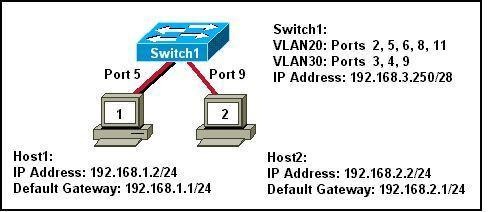
Refer to the exhibit. What two statements can be concluded from the information that is shown in the exhibit? (Choose two.)
• All ports that are listed in the exhibit are access ports.
• ARP requests from Host1 will be forwarded to Host2.
• Attaching Host1 to port 3 will automatically allow communication between both hosts.
• The default gateway for each host must be changed to 192.168.3.250/28 to allow communication between both hosts.
• A router connected to the switch is needed to forward traffic between the hosts.
Jawaban
• The default gateway for each host must be changed to 192.168.3.250/28 to allow communication between both hosts.
2.
A router is configured to connect to a trunked uplink as shown in the exhibit. A packet is received on the FastEthernet 0/1 physical interface from VLAN 10. The packet destination address is 192.168.1.120. What will the router do with this packet?
• The router will forward the packet out interface FastEthernet 0/1.1 tagged for VLAN 10.
• The router will forward the packet out interface FastEthernet 0/1.2 tagged for VLAN 60.
• The router will forward the packet out interface FastEthernet 0/1.3 tagged for VLAN 60.
• The router will forward the packet out interface FastEthernet 0/1.3 tagged for VLAN 120.
• The router will not process the packet since the source and destination are on the same subnet.
• The router will drop the packet since no network that includes the source address is attached to the router.
Jawaban
• The router will forward the packet out interface FastEthernet 0/1.3 tagged for VLAN 120.
3. The information contained in a BPDU is used for which two purposes? (Choose two.)
• to prevent loops by sharing bridging tables between connected switches
• to set the duplex mode of a redundant link
• to determine the shortest path to the root bridge
• to determine which ports will forward frames as part of the spanning tree
• to activate looped paths throughout the network
4. A router has two serial interfaces and two Fast Ethernet interfaces. This router must be connected to a WAN link and to a switch that supports four VLANs. How can this be accomplished in the most efficient and cost-effective manner to support inter-VLAN routing between the four VLANs?
• Connect a smaller router to the serial interface to handle the inter-VLAN traffic.
• Add two additional Fast Ethernet interfaces to the router to allow one VLAN per interface.
• Connect a trunked uplink from the switch to one Fast Ethernet interface on the router and create logical subinterfaces for each VLAN.
• Use serial-to-Fast Ethernet transceivers to connect two of the VLANs to the serial ports on the router. Support the other two VLANs directly to the available FastEthernet ports.
5. When are MAC addresses removed from the CAM table?
• at regular 30 second intervals
• when a broadcast packet is received
• when the IP Address of a host is changed
• after they have been idle for a certain period of time
6.
Refer to the exhibit. Switch1 is not participating in the VTP management process with the other switches. Which two are possible reasons for this? (Choose two.)
• Switch2 is in transparent mode.
• Switch1 is in client mode.
• Switch1 is using VTP version 1 and Switch2 is using VTP version 2.
• Switch2 is in server mode.
• Switch1 is in a different management domain.
• Switch1 has no VLANs.
7. Which three must be used when a router interface is configured for VLAN trunking? (Choose three.)
• one subinterface per VLAN
• one physical interface for each subinterface
• one IP network or subnetwork for each subinterface
• one trunked link per VLAN
• a management domain for each subinterface
• a compatible trunking protocol encapsulation for each subinterface
8.
Refer to the exhibit. The switches are connected with trunks within the same VTP management domain. Each switch is labeled with its VTP mode. A new VLAN is added to Switch3. This VLAN does not show up on the other switches. What is the reason for this?
• VLANs cannot be created on transparent mode switches.
• Server mode switches neither listen to nor forward VTP messages from transparent mode switches.
• VLANs created on transparent mode switches are not included in VTP advertisements.
• There are no ports assigned to the new VLAN on the other switches.
• Transparent mode switches do not forward VTP advertisements.
9. Which two criteria are used by STP to select a root bridge? (Choose two.)
• memory size
• bridge priority
• switching speed
• number of ports
• base MAC address
• switch location
10. Which three steps should be taken before moving a Catalyst switch to a new VTP management domain? (Choose three.)
• Reboot the switch.
• Reset the VTP counters to allow the switch to synchronize with the other switches in the domain.
• Download the VTP database from the VTP server in the new domain.
• Configure the VTP server in the domain to recognize the BID of the new switch.
• Select the correct VTP mode and version.
• Configure the switch with the name of the new management domain.
11. Which two items will prevent broadcasts from being sent throughout the network? (Choose two.)
• bridges
• routers
• switches
• VLANs
• hubs
12. Which two characteristics describe a port in the STP blocking state? (Choose two.)
• provides port security
• displays a steady green light
• learns MAC addresses as BPDUs are processed
• discards data frames received from the attached segment
• receives BPDUs and directs them to the system module
13. What is the first step in the process of convergence in a spanning tree topology?
• election of the root bridge
• determination of the designated port for each segment
• blocking of the non-designated ports
• selection of the designated trunk port
• activation of the root port for each segment
14. In which STP state does a switch port transmit user data and learn MAC addresses?
• blocking
• learning
• disabling
• listening
• forwarding
15. What is the purpose of VTP?
• maintaining consistency in VLAN configuration across the network
• routing frames from one VLAN to another
• routing the frames along the best path between switches
• tagging user data frames with VLAN membership information
• distributing BPDUs to maintain loop-free switched paths
16. Which statement best describes adaptive cut-through switching?
• The switch initially forwards all traffic using cut-through switching and then changes to store-and-forward switching if errors exceed a threshold value.
• The switch initially forwards all traffic using cut-through switching and then changes to fast-forward switching if errors exceed a threshold value.
• The switch initially forwards all traffic using cut-through switching and then temporarily disables the port if errors exceed a threshold value.
• The switch initially forwards all traffic using store-and-forward switching and then changes to cut-through switching if errors exceed a threshold value.
17. Using STP, how long does it take for a switch port to go from the blocking state to the forwarding state?
• 2 seconds
• 15 seconds
• 20 seconds
• 50 seconds
18.
Refer to the exhibit. The switches are interconnected by trunked links and are configured for VTP as shown. A new VLAN is added to Switch1. Which three actions will occur? (Choose three.)
• Switch1 will not add the VLAN to its database and will pass the update to Switch 2.
• Switch2 will add the VLAN to its database and pass the update to Switch3.
• Switch3 will pass the VTP update to Switch4.
• Switch3 will add the VLAN to its database.
• Switch4 will add the VLAN to its database.
• Switch4 will not receive the update.
19 Which Catalyst feature causes a switch port to enter the spanning-tree forwarding state immediately?
• backbonefast
• uplinkfast
• portfast
• rapid spanning tree
20.
Refer to the exhibit. Which set of commands would be used on the router to provide communication between the two hosts connected to the switch?
• Router(config)# interface vlan 2
Router(config-if)# ip address 192.168.2.1 255.255.255.0
Router(config-if)# no shutdown
Router(config)# interface vlan 3
Router(config-if)# ip address 192.168.3.1 255.255.255.0
Router(config-if)# no shutdown
• Router(config)# interface fastethernet 0/0
Router(config-if)# no shutdown
Router(config-if)# interface fastethernet 0/0.2
Router(config-subif)# encapsulation dot1q 2
Router(config-subif)# ip address 192.168.2.1 255.255.255.0
Router(config-if)# interface fastethernet 0/0.3
Router(config-subif)# encapsulation dot1q 3
Router(config-subif)# ip address 192.168.3.1 255.255.255.0
• Router(config)# interface vlan 2
Router(config-if)# switchport mode trunk dot1q
Router(config)# interface vlan 3
Router(config-if)# switchport mode trunk dot1q
• Router(config)# interface fastethernet 0/0
Router(config-if)# mode trunk dot1q 2 3
Router(config-if)# ip address 192.168.2.1 255.255.255.0
1.
Refer to the exhibit. What two statements can be concluded from the information that is shown in the exhibit? (Choose two.)
• All ports that are listed in the exhibit are access ports.
• ARP requests from Host1 will be forwarded to Host2.
• Attaching Host1 to port 3 will automatically allow communication between both hosts.
• The default gateway for each host must be changed to 192.168.3.250/28 to allow communication between both hosts.
• A router connected to the switch is needed to forward traffic between the hosts.
Jawaban
• The default gateway for each host must be changed to 192.168.3.250/28 to allow communication between both hosts.
2.
A router is configured to connect to a trunked uplink as shown in the exhibit. A packet is received on the FastEthernet 0/1 physical interface from VLAN 10. The packet destination address is 192.168.1.120. What will the router do with this packet?
• The router will forward the packet out interface FastEthernet 0/1.1 tagged for VLAN 10.
• The router will forward the packet out interface FastEthernet 0/1.2 tagged for VLAN 60.
• The router will forward the packet out interface FastEthernet 0/1.3 tagged for VLAN 60.
• The router will forward the packet out interface FastEthernet 0/1.3 tagged for VLAN 120.
• The router will not process the packet since the source and destination are on the same subnet.
• The router will drop the packet since no network that includes the source address is attached to the router.
Jawaban
• The router will forward the packet out interface FastEthernet 0/1.3 tagged for VLAN 120.
3. The information contained in a BPDU is used for which two purposes? (Choose two.)
• to prevent loops by sharing bridging tables between connected switches
• to set the duplex mode of a redundant link
• to determine the shortest path to the root bridge
• to determine which ports will forward frames as part of the spanning tree
• to activate looped paths throughout the network
4. A router has two serial interfaces and two Fast Ethernet interfaces. This router must be connected to a WAN link and to a switch that supports four VLANs. How can this be accomplished in the most efficient and cost-effective manner to support inter-VLAN routing between the four VLANs?
• Connect a smaller router to the serial interface to handle the inter-VLAN traffic.
• Add two additional Fast Ethernet interfaces to the router to allow one VLAN per interface.
• Connect a trunked uplink from the switch to one Fast Ethernet interface on the router and create logical subinterfaces for each VLAN.
• Use serial-to-Fast Ethernet transceivers to connect two of the VLANs to the serial ports on the router. Support the other two VLANs directly to the available FastEthernet ports.
5. When are MAC addresses removed from the CAM table?
• at regular 30 second intervals
• when a broadcast packet is received
• when the IP Address of a host is changed
• after they have been idle for a certain period of time
6.
Refer to the exhibit. Switch1 is not participating in the VTP management process with the other switches. Which two are possible reasons for this? (Choose two.)
• Switch2 is in transparent mode.
• Switch1 is in client mode.
• Switch1 is using VTP version 1 and Switch2 is using VTP version 2.
• Switch2 is in server mode.
• Switch1 is in a different management domain.
• Switch1 has no VLANs.
7. Which three must be used when a router interface is configured for VLAN trunking? (Choose three.)
• one subinterface per VLAN
• one physical interface for each subinterface
• one IP network or subnetwork for each subinterface
• one trunked link per VLAN
• a management domain for each subinterface
• a compatible trunking protocol encapsulation for each subinterface
8.
Refer to the exhibit. The switches are connected with trunks within the same VTP management domain. Each switch is labeled with its VTP mode. A new VLAN is added to Switch3. This VLAN does not show up on the other switches. What is the reason for this?
• VLANs cannot be created on transparent mode switches.
• Server mode switches neither listen to nor forward VTP messages from transparent mode switches.
• VLANs created on transparent mode switches are not included in VTP advertisements.
• There are no ports assigned to the new VLAN on the other switches.
• Transparent mode switches do not forward VTP advertisements.
9. Which two criteria are used by STP to select a root bridge? (Choose two.)
• memory size
• bridge priority
• switching speed
• number of ports
• base MAC address
• switch location
10. Which three steps should be taken before moving a Catalyst switch to a new VTP management domain? (Choose three.)
• Reboot the switch.
• Reset the VTP counters to allow the switch to synchronize with the other switches in the domain.
• Download the VTP database from the VTP server in the new domain.
• Configure the VTP server in the domain to recognize the BID of the new switch.
• Select the correct VTP mode and version.
• Configure the switch with the name of the new management domain.
11. Which two items will prevent broadcasts from being sent throughout the network? (Choose two.)
• bridges
• routers
• switches
• VLANs
• hubs
12. Which two characteristics describe a port in the STP blocking state? (Choose two.)
• provides port security
• displays a steady green light
• learns MAC addresses as BPDUs are processed
• discards data frames received from the attached segment
• receives BPDUs and directs them to the system module
13. What is the first step in the process of convergence in a spanning tree topology?
• election of the root bridge
• determination of the designated port for each segment
• blocking of the non-designated ports
• selection of the designated trunk port
• activation of the root port for each segment
14. In which STP state does a switch port transmit user data and learn MAC addresses?
• blocking
• learning
• disabling
• listening
• forwarding
15. What is the purpose of VTP?
• maintaining consistency in VLAN configuration across the network
• routing frames from one VLAN to another
• routing the frames along the best path between switches
• tagging user data frames with VLAN membership information
• distributing BPDUs to maintain loop-free switched paths
16. Which statement best describes adaptive cut-through switching?
• The switch initially forwards all traffic using cut-through switching and then changes to store-and-forward switching if errors exceed a threshold value.
• The switch initially forwards all traffic using cut-through switching and then changes to fast-forward switching if errors exceed a threshold value.
• The switch initially forwards all traffic using cut-through switching and then temporarily disables the port if errors exceed a threshold value.
• The switch initially forwards all traffic using store-and-forward switching and then changes to cut-through switching if errors exceed a threshold value.
17. Using STP, how long does it take for a switch port to go from the blocking state to the forwarding state?
• 2 seconds
• 15 seconds
• 20 seconds
• 50 seconds
18.
Refer to the exhibit. The switches are interconnected by trunked links and are configured for VTP as shown. A new VLAN is added to Switch1. Which three actions will occur? (Choose three.)
• Switch1 will not add the VLAN to its database and will pass the update to Switch 2.
• Switch2 will add the VLAN to its database and pass the update to Switch3.
• Switch3 will pass the VTP update to Switch4.
• Switch3 will add the VLAN to its database.
• Switch4 will add the VLAN to its database.
• Switch4 will not receive the update.
19 Which Catalyst feature causes a switch port to enter the spanning-tree forwarding state immediately?
• backbonefast
• uplinkfast
• portfast
• rapid spanning tree
20.
Refer to the exhibit. Which set of commands would be used on the router to provide communication between the two hosts connected to the switch?
• Router(config)# interface vlan 2
Router(config-if)# ip address 192.168.2.1 255.255.255.0
Router(config-if)# no shutdown
Router(config)# interface vlan 3
Router(config-if)# ip address 192.168.3.1 255.255.255.0
Router(config-if)# no shutdown
• Router(config)# interface fastethernet 0/0
Router(config-if)# no shutdown
Router(config-if)# interface fastethernet 0/0.2
Router(config-subif)# encapsulation dot1q 2
Router(config-subif)# ip address 192.168.2.1 255.255.255.0
Router(config-if)# interface fastethernet 0/0.3
Router(config-subif)# encapsulation dot1q 3
Router(config-subif)# ip address 192.168.3.1 255.255.255.0
• Router(config)# interface vlan 2
Router(config-if)# switchport mode trunk dot1q
Router(config)# interface vlan 3
Router(config-if)# switchport mode trunk dot1q
• Router(config)# interface fastethernet 0/0
Router(config-if)# mode trunk dot1q 2 3
Router(config-if)# ip address 192.168.2.1 255.255.255.0
Langganan:
Postingan (Atom)